
 By
By 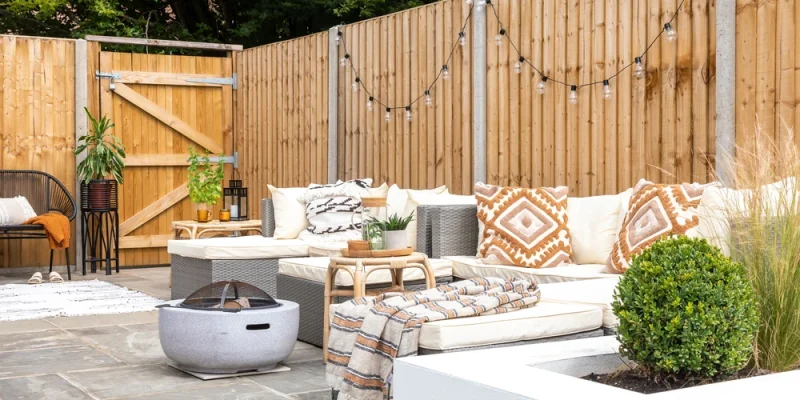
For most of my working life, people have talked about fencing as a boundary. It marks where one property ends and another begins, keeps children and dogs in, provides some security and stops the garden feeling quite so exposed. All of that still matters, but I’m increasingly seeing garden fencing being asked to do another job. It has become part of how the garden itself is designed and used.
That might sound like a small distinction. It isn’t.
Gardens are changing.
Instead of one lawn, a patio and a shed at the bottom, more households are creating separate areas for eating, relaxing, playing, growing vegetables, storing bikes or bins and simply getting a little privacy.
The fence is no longer just around the room.
In many gardens, it is becoming one of the walls.
We expect more from gardens now
The way people use outdoor space has changed noticeably.
A patio table might once have been brought out for the occasional barbecue. Now you see permanent seating areas, outdoor kitchens, pergolas, lighting, hot tubs, home offices, children’s play areas and proper covered spaces designed to be used for much more of the year.
Even fairly modest gardens are being divided into zones.
That changes how a boundary feels.
If you only ever look at your garden while mowing the lawn, an ageing fence at the bottom might not bother you. Put a seating area two metres away from it and suddenly you notice every leaning post, uneven panel and gap between the boards.
Privacy becomes more noticeable too.
People naturally want to feel comfortable where they sit. A garden can technically be enclosed while still feeling remarkably exposed if neighbouring windows, paths or adjoining seating areas overlook it.
I’ve visited plenty of gardens where the problem wasn’t that the fence was too old. It was that the garden had changed around it.
The boundary no longer suited the way the owners wanted to use the space.
A small garden has to work particularly hard
This trend is especially interesting in smaller gardens.
You don’t need a huge plot to create different areas, but you do need to think carefully about how you divide it.
Put too many solid structures into a compact garden and it can feel boxed in. Use nothing at all and the barbecue, bins, children’s toys and seating can end up competing for the same visual space.
Fencing and screening can help, but restraint matters.
I’ve never understood the temptation to solve every garden problem by installing another six-foot solid panel.
Sometimes a lower screen is enough.
Sometimes a short run of slatted fencing can disguise bins without making the garden feel smaller. A well-positioned gate can separate a side passage from the main garden. Planting can do some of the work instead of timber.
The best solution is often a mixture.
Good fencing doesn’t have to shout for attention.
Privacy isn’t simply about fence height
One of the first things people ask when they want more privacy is how high the fence can be.
That’s understandable, but height is only part of the problem.
You need to work out where the overlooking is actually coming from.
If the neighbour’s patio is on roughly the same level as yours, increasing the height of a boundary may make a significant difference. If you’re trying to screen an upstairs bedroom window, adding another foot to a fence probably isn’t going to achieve what you imagine.
Levels matter too.
South Yorkshire gardens aren’t all conveniently flat. I’ve worked around enough slopes to know that a fence measured from one side can feel completely different from the other. Raised patios and decking make that even more obvious.
Before changing a boundary purely for privacy, stand where you actually intend to sit.
That’s the view that matters.
I’ve seen people spend considerable amounts replacing entire boundaries when a much smaller section of screening in the right position would have solved the problem.
The view from inside the house matters as well
This gets overlooked.
A fence is one of the largest visual features in many gardens. On a typical residential plot, you might have tens of metres of it visible from the kitchen, dining room or living room.
If the garden is becoming another living area, it makes sense to think about the boundary in much the same way you would think about a wall inside the house.
Not necessarily in terms of decoration, but proportion, condition and what surrounds it.
A beautifully finished patio against collapsing lap panels is always going to look unfinished.
Likewise, spending heavily on landscaping while ignoring rotten posts is risky. The landscaper can make everything around the fence look fantastic, but if the boundary needs replacing two winters later, somebody may have to work around new paving, raised beds and expensive planting to get to it.
I’ve encountered that situation more times than I care to remember.
If you’re undertaking a major garden renovation, inspect the boundary first.
It is considerably easier to replace a fence before the garden around it becomes precious.
Zoning creates new uses for gates
The humble garden gate has become more useful as gardens have become more complicated.
Traditionally, the gate was usually positioned down the side of the house. It got you from the front to the back without walking through the property.
It still does.
But internal gates can also separate areas of a garden.
Families might want to keep a dog away from a children’s play area, restrict access to a vegetable patch or separate a working part of the garden from the place where they entertain.
The important thing is to avoid creating obstacles for the sake of it.
Every gate introduces posts, hinges, a latch and something else that needs to remain aligned. If you can create the same division using planting or layout, that may be preferable.
Where a garden gate is genuinely useful, its supporting structure deserves as much thought as the gate itself.
A heavy gate hanging from an inadequate timber post will eventually make its feelings known.
Usually by scraping across the ground.
Materials are becoming part of the design decision
For years, the standard conversation was often fairly simple: what type of timber panel do you want?
There is far more choice now.
Traditional closeboard and feather edge fencing still make sense in a huge number of gardens. Properly installed timber is versatile, repairable and suits most British properties.
Concrete posts and gravel boards remain popular because they remove timber from some of the areas most vulnerable to decay.
Then there is composite.
I’ve noticed much more interest in it as homeowners have started thinking about boundaries as part of a broader landscaped finish rather than an isolated practical purchase.
There are advantages, particularly for people who don’t want the routine treatment associated with some timber products. But I’d never recommend choosing composite fencing purely because somebody saw a pristine photograph online.
Look at the whole system.
Posts matter. Fixings matter. Ground conditions matter. Wind exposure matters.
A premium-looking board doesn’t compensate for inadequate foundations.
It is the same lesson fencing has been teaching people for decades.
Don’t forget what happens in winter
Garden design photographs tend to be taken in summer.
Everything is green. Plants are full. The furniture is out and the light is flattering.
A Yorkshire garden in February is less forgiving.
Deciduous plants lose their leaves. Outdoor furniture may disappear into storage. Borders die back. The underlying structure of the garden becomes much more visible.
That’s often when fencing has the greatest visual impact.
It is also when it is doing some of its hardest physical work.
Wet ground, repeated rain and strong winds don’t particularly care how attractive the garden looked in July.
If you’re incorporating fencing into a new garden layout, think about exposure before appearance.
Solid fencing can provide useful shelter, but it also catches wind. An exposed boundary backing onto open ground experiences different forces from a sheltered fence squeezed between neighbouring properties.
Barnsley has plenty of both.
There are tightly packed terraces and established suburban streets, but travel towards the edges of the town and surrounding villages and you quickly find properties facing much more open countryside.
That difference matters.
Old boundaries can sometimes be incorporated rather than replaced
A garden redesign doesn’t automatically require a new fence.
This is where I think homeowners can save money.
If the posts, rails and boards are sound, an existing timber fence might simply need cleaning, minor repairs or treatment. Planting can soften it. A small amount of screening can be introduced around a seating area without touching the rest of the boundary.
Don’t replace sound materials simply because you’re changing the patio.
Inspect first.
I’ve always preferred spending money where it solves an actual problem.
On the other hand, if posts are already moving, rails are rotten and several previous repairs are visible, address that before building expensive features immediately in front of them.
Access is one of the least glamorous considerations in garden design, but contractors think about it constantly.
Can I reach the posts?
Can old panels be removed?
Where does the waste go?
Can materials be carried through the side entrance?
A fence that is straightforward to replace in an empty garden can become a very different job once raised beds, rendered walls, porcelain paving and a garden building have been constructed around it.
The boundary should support the garden, not dominate it
There is a tendency with home improvements to assume that more expensive means more impressive.
Fencing doesn’t really work like that.
Some of the nicest gardens I’ve worked around have had remarkably simple boundaries. They work because the proportions are right, the installation is good and the fence isn’t fighting everything else for attention.
That matters more now that gardens are expected to do so many jobs.
You might want privacy around the table but openness near the lawn. You might need security at the side passage but only a visual screen around the bins. The bottom boundary might need to withstand strong winds while the fence beside the house barely experiences them.
There is no reason all of those sections have to perform identically.
For decades we treated fencing as something that went around a garden.
As people increasingly treat their gardens as somewhere to live rather than simply somewhere outside the house, that way of thinking is changing.
And once a garden starts behaving like another room, it is probably worth giving some thought to the walls.




Comments